
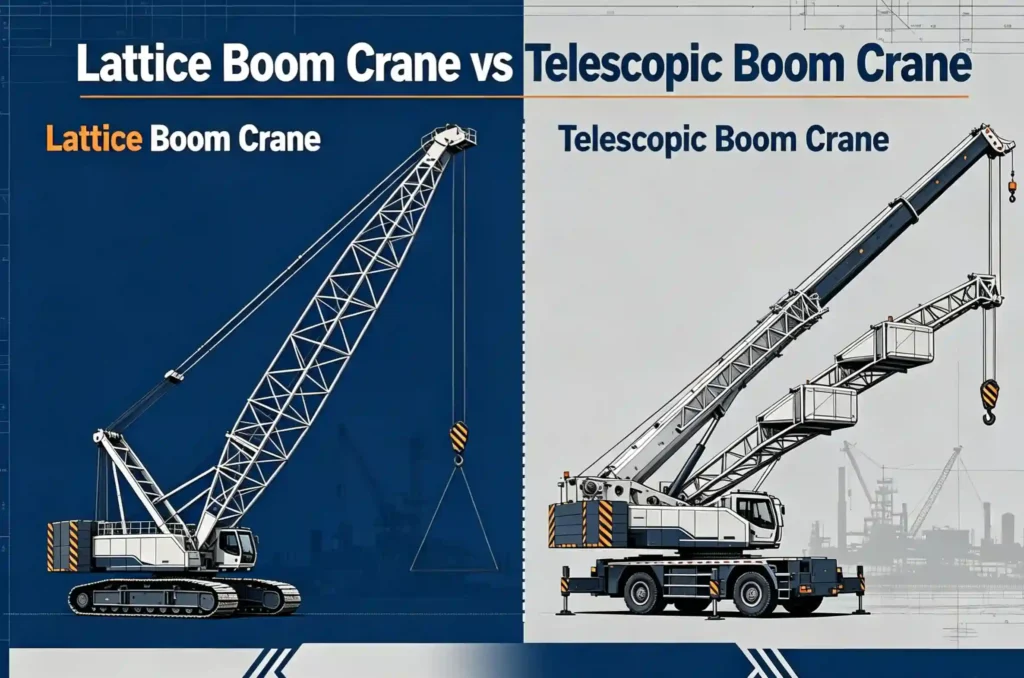
Lattice Boom Crane
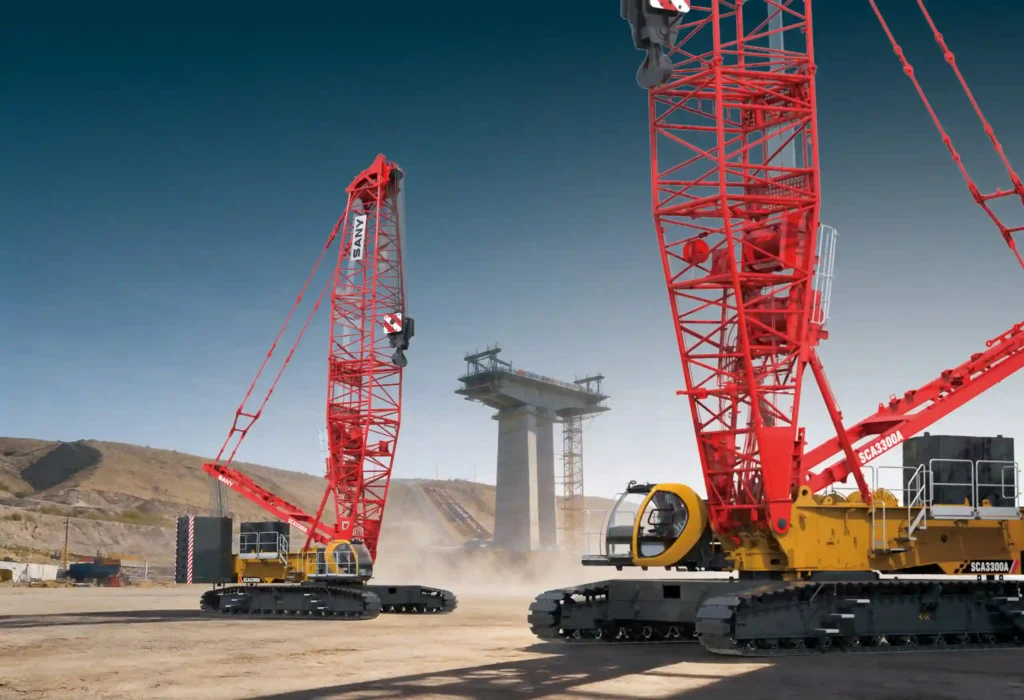
A lattice boom crane is a type of mobile crane that uses a boom with a truss-like structure. The boom is built by welding high-strength steel tubes into a grid pattern. It is assembled on-site to reach the needed length.
Unlike hydraulic telescopic boom cranes, these cranes are not known for their mobility. Instead, they are designed for ” lifting” tasks. They are usually mounted on a crawler chassis. This allows them to work stably on the ground. They can even move distances while carrying a load.
Key Features
1. Boom Structural Characteristics
Truss Grid Design: The boom has an open-web structure made by welding steel tubes into “W” or “V” shapes. This looks similar to a transmission tower.
Lightweight yet High-Strength: The open-web design gives support while keeping the boom light in weight. This lets it reach lengths without bending under its own weight.
Modular Assembly: The boom is made of sections. These are put together on-site using a crane. Unlike booms, it cannot extend or retract automatically.
2. Chassis and Mobility Characteristics
Crawler Chassis: The large contact area with the ground reduces pressure. This makes it suitable for muddy construction sites.
Load-Carrying Travel: It can move slowly over distances while holding a load. This is hard for wheeled cranes to do.
Modular Structure: For large models, parts such as the chassis, counterweights, and tracks must be sent separately. They are put together on-site. This means setup times and relocation periods.
3. Power and Control Characteristics
Multiple Power Sources: Most are powered by diesel engines. Some large models can use power to reduce emissions.
Multi-Winch System: These cranes have main and auxiliary winches. These control hook. Adjust the boom angle.
Superlift System: Large models often include “Superlift” masts and counterweights attached to the boom. These greatly increase lifting capacity.
4. Lifting Performance Characteristics
Massive Lifting Capacity: Common models range from 100 tons to over 2,500 tons. A 250-ton class lattice boom crane can lift as much as a 400-ton hydraulic crane.
Exceptional Lifting Height: When fitted with a jib, it can easily go beyond 100 meters in height. This makes it ideal for wind turbine installation and steel structure work on high-rise buildings.
Superior Wind Resistance: The open-web truss design presents surface area to wind. This provides stability during high-altitude operations compared to box-section booms.
5. Operational Scenario Characteristics
Project-based and term: These cranes are suited for large construction projects that last months or even years. They are not good for jobs requiring frequent moves.
Typical Applications: Wind turbine installation, large bridge building, heavy module lifting at plants or chemical facilities, and offshore engineering.
Telescopic Boom Crane
A telescopic boom crane is a type of lifting equipment with an extending boom. The boom is made of box-section steel. You can think of it like a telescope made of nested steel boxes. These boxes are sized and fit inside one another. Hydraulic cylinders push them out. Pull them back just like an antenna moving.
Key Features
Hydraulic Extension for Immediate Operation: This is the advantage. Operators can control the boom’s extension and retraction using joysticks from the cab. They can finish this process in minutes. Unlike lattice-boom cranes that need on-site assembly, this one is ready to work as soon as the vehicle arrives.
Wheeled Chassis for Rapid Relocation: Most telescopic boom cranes sit on a wheeled chassis. They can travel on roads using their own power. After finishing a job, the operator just retracts the outriggers and drives to the site. This offers flexibility.
Box-Section Design for Strength and Rigidity: The boom has an enclosed box-shaped structure. There are reinforcing ribs. Although heavier than lattice-style booms, this design resists bending and twisting forces from all directions.
Outrigger System for a Stable Foundation: Because wheeled chassis are less stable than tracked ones, the crane needs support. During operation, four hydraulic outriggers extend outward. They lift the chassis. Create a solid base for safe working.
Lattice Boom Crane vs Telescopic Boom Crane
| Comparison Aspect | Lattice Boom Crane | Telescopic Boom Crane |
| Boom Structure | Lattice (truss) frame made of welded steel tubes; open-grid, cross-braced design. | Multi-section box-section booms that slide into one another (hydraulically telescoped). |
| Boom Assembly | Requires manual assembly on-site by adding or removing bolt-on sections. | Self-erecting: boom extends/retracts hydraulically via the operator’s cab, no external crane needed. |
| Boom Length | Can reach extreme lengths (easily over 150 meters / 490 feet) by adding more sections. | Limited by transport and hydraulic cylinder size (typically up to ~100 meters / 330 feet for the largest models). |
| Weight Efficiency | Extremely lightweight relative to its strength; the open structure saves significant dead weight. | Heavier for the same capacity because the box boom must be strong enough to support itself when fully extended. |
| Lifting Capacity | Superior for heavy loads at high radii and extreme heights. A 250t lattice crane can often outperform a 400t telescopic crane. | Excellent for moderate to heavy loads, but capacity drops off sharply as the boom extends. Best for shorter-radius, high-capacity lifts. |
| Wind Resistance | Excellent: the open lattice allows wind to pass through, reducing lateral force and sway. | Poorer: the large flat surface of the box boom catches more wind, affecting stability at height. |
| Mobility & Travel | Usually crawler-mounted (tracked). Can travel slowly on-site with loads (pick-and-carry), but requires multiple trucks to transport between job sites. | Usually wheel-mounted (truck or all-terrain chassis). High road mobility; drives on public roads under its own power, ready to work shortly after arrival. |
| Setup Time | Slow: requires crane assembly, boom section pinning, and rigging of pendants. Can take hours or even days for large models. | Fast: outriggers deploy and boom extends within minutes. Ideal for jobs where time is critical. |
| Ground Pressure | Low: wide crawler tracks distribute the enormous weight evenly, suitable for soft or uneven terrain. | High: requires firm, level ground or steel mats; outriggers concentrate loads on small pads. |
| On-Site Maneuverability | Can crawl with a load (pick-and-carry) over short distances on prepared surfaces. | Cannot travel with a load (except small rough-terrain cranes); must be repositioned and re-set for each lift. |
| “Superlift” / Derrick Attachments | Commonly equipped with superlift (guyed masts and counterweight trays) to boost capacity by 30-50% at long radii. | Rarely used: most telescopic cranes do not support such attachments due to boom design limitations. |
| Typical Applications | Long-term, large-scale projects: wind turbine installation, nuclear/chemical plant module lifts, heavy bridge girders, shipyard / offshore construction. | Short-term, multi-site jobs: urban construction, equipment moving, factory maintenance, emergency repairs, and general cargo handling. |
| Cost & Logistics | High overall project cost: requires heavy transport fleets, additional support cranes for assembly, and large crew. Economical for long-duration projects. | Lower mobilization cost: single unit drives to site. Economical for short-duration, fast-turnaround tasks. |
| Operator Skill Requirement | High: requires coordination with rigging crews and often uses multiple winches and boom-hoist lines simultaneously. | Standard: The main focus is joystick control. Computerized load moment indicators(LMI), simplify operation. |