
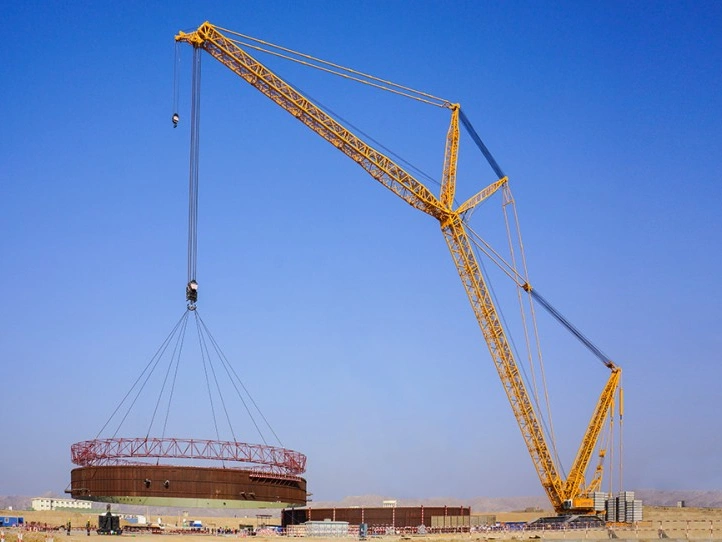
When one crane has lifted a load weighing 3,371 tons, which is 12% above its own capacity, and shipped its most weighty component through a regular 20-foot container, it becomes more than engineering.
The following discussion will explore the technical aspects of the Liebherr LR 13000, including its specifications and innovative features, using factual data and documented project information.
Core Specifications:
Parameter Value
Maximum lifting capacity 3,000 t at 12 m radius
Luffing jib length Up to 126 m
Maximum load torque 65,000 t·m
Maximum hoist height 236 m
Engine power 1,000 kW
Maximum radius 200 m
Main boom length Up to 144 m
Maximum system length 246 m
Source: Liebherr product documentation
To put the scale in perspective: each crawler track frame weighs approximately 210 tons, with the 82-ton tracks removed and containerized for transport. The hook block alone weighs 111 tons. Fully rigged with 750 tons of superstructure ballast and 1,500 tons of derrick ballast, the LR 13000 operates at a total weight of 3,500 tons.
Applications of Liebherr LR 13000 Crawler Crane
Nuclear power plant construction — where pre-assembled modules continue increasing in unit weight
Refinery modernization — industrial columns reaching 1,500 tons and 100 meters in length
Large-scale industrial projects requiring continuous heavy lifts over extended periods
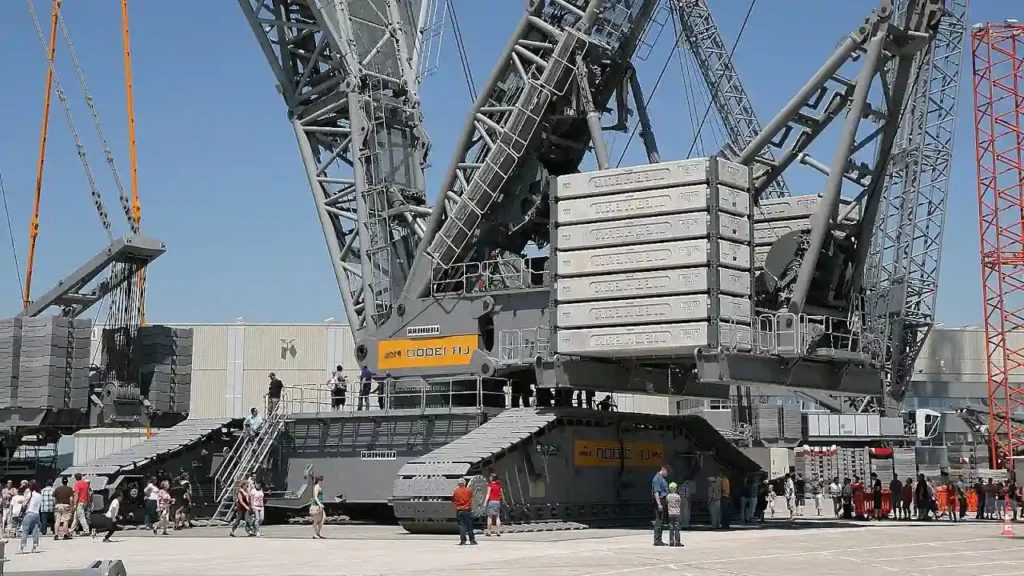
No Derrick Ballast – A Defining Feature for the Class
The LR 13000 is the first crawler crane in the 3,000-ton class capable of working without derrick ballast. This is made possible by the use of a Liebherr-made slewing ring, which transfers considerably more torque than any conventional ringer mechanism.
This means that:
By operating without the need for derrick ballast, the crane reduces its setup times. For partial lifts, which constitute the vast majority of operations during large-scale projects, the LR 13000 can be set up much faster without having to position several thousand tons of ballast.
In order to increase no-derrick capacity, the standard superstructure ballast was increased from 400 tons to 750 tons. This is a compromise, where the crane uses heavier turntable ballast rather than suspended ballast, giving project managers greater flexibility than ever before.
If necessary, the crane can also use a full derrick ballast system with a capacity of 1,500 tons, which can be set between 20 and 30 meters ballast radius without guide ropes.
PowerBoom: The 50% Capacity Multiplier
The LR 13000 employs the innovative PowerBoom parallel boom technology from Liebherr – a revolutionary concept that can also be found in the LR 11000 and LR 11350 cranes.
The PowerBoom principle involves fitting lattice segments side by side at the bottom end of the main boom. The two booms span 48 meters before merging to create a standard boom at the top. This innovation delivers:
Safety and Reliability: Redundant Design
The LR 13000 has redundant drive systems that make it effectively fail-safe.
This design feature is especially important when using the LR 13000 for constructing nuclear power plants, one of its main intended uses. According to regulations, lift operations with reactor components and safety-relevant structures must be fail-operational.
The fact that Liebherr designs and manufactures the slewing ring, booms, and drive systems ensures total quality control of the critical components of the crane’s operation.